Virtual book launch with Dr. Marco Posadas
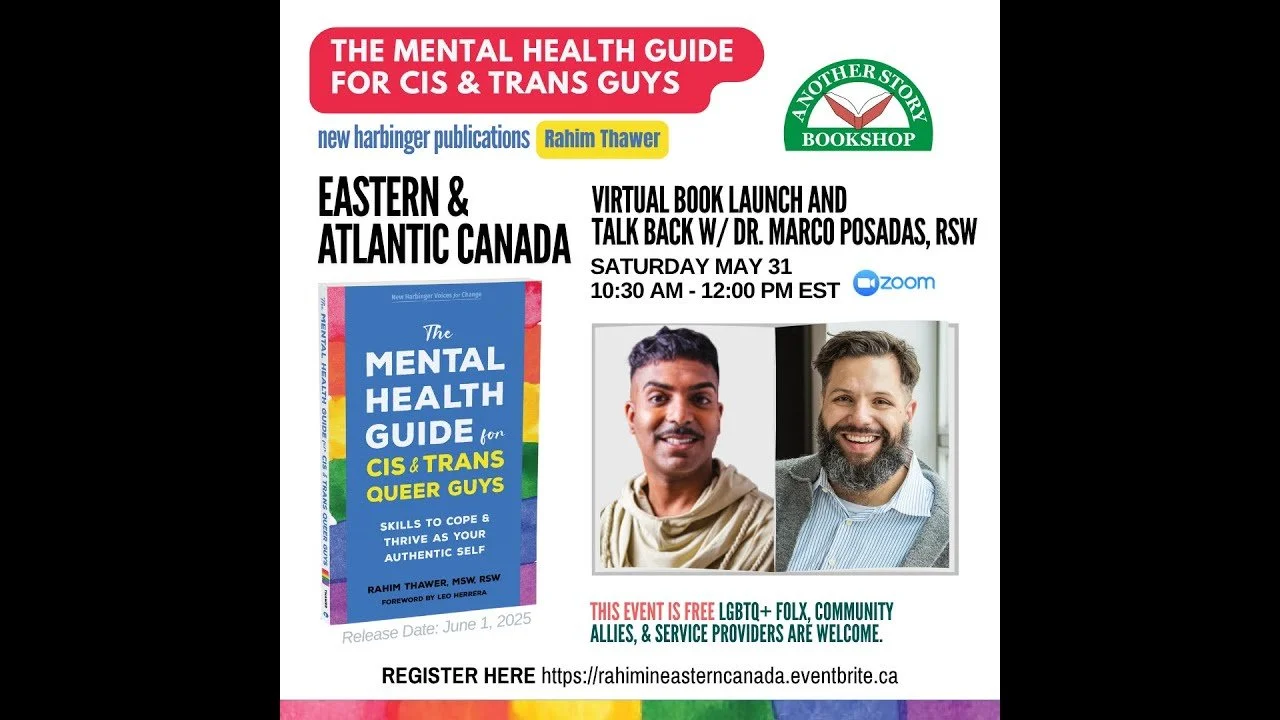
Book launch · Another Story Bookstore · May 2025 · 1 hr 25 min
The virtual launch of The Mental Health Guide for Cis and Trans Queer Guys, held with Another Story Bookshop the day before its June 2025 release. Rahim is in conversation with Dr. Marco Posadas, a psychotherapist and psychoanalyst who has known him since 2009, when both worked on bathhouse counselling and sexual health outreach in Toronto.
Rahim explains that years in the HIV sector showed him how queer men’s mental health work was often funnelled through sexual health funding. He wanted to honour the impact of AIDS while decentring it, looking instead at the population-specific determinants, like internalized shame, body culture and subcultural hierarchies, that sit beneath shared diagnostic labels. He traces the book’s opening line to a family moment about inherited expectations and describes the grief of being a queer child of immigrants.
Much of the conversation turns clinical. Rahim describes how a queer therapist’s own shame can be activated by clients, and how a well-meaning straight therapist might unknowingly collude with homophobia, for example by treating casual sex as a problem to fix. He explains why he combined cognitive behavioural therapy, gestalt empty-chair work and psychodynamic thinking, pressing his publisher to recognize insight and memorable experience as forms of evidence, not just symptom scores.
He discusses the “landscape of connection seeking,” including the acculturative stress of moving from heteronormative scripts into gay subcultures, and the book’s chapters on seeking connection, endings and managing rejection. On substance use, he outlines a harm reduction approach that adapts an activator-behaviour-consequence chart, using the example of a payday night out. He also shares how his editor’s suggestion to write for a composite reader shaped the book, and how milestone heteronormativity grew into its own chapter.
In the audience discussion, Rahim advises a residential worker supporting a trans queer man not to treat heterosexuality as a marker of wellness, to support the family’s grief, and not to equate identity with symptoms. He encourages a youth organization to learn the language young people use and partner with trusted queer creators. He closes by pointing to his forthcoming three-volume book, The Politicized Practitioner.
What it covers
- Purpose and vision of the book
- Population-specific social determinants
- Integrating CBT, gestalt and psychodynamic approaches
- Landscape of connection seeking
- Harm reduction and substance use
Related on this site
Archived record: doi.org/10.5281/zenodo.19035690