What it takes to build queer-affirming mental health care
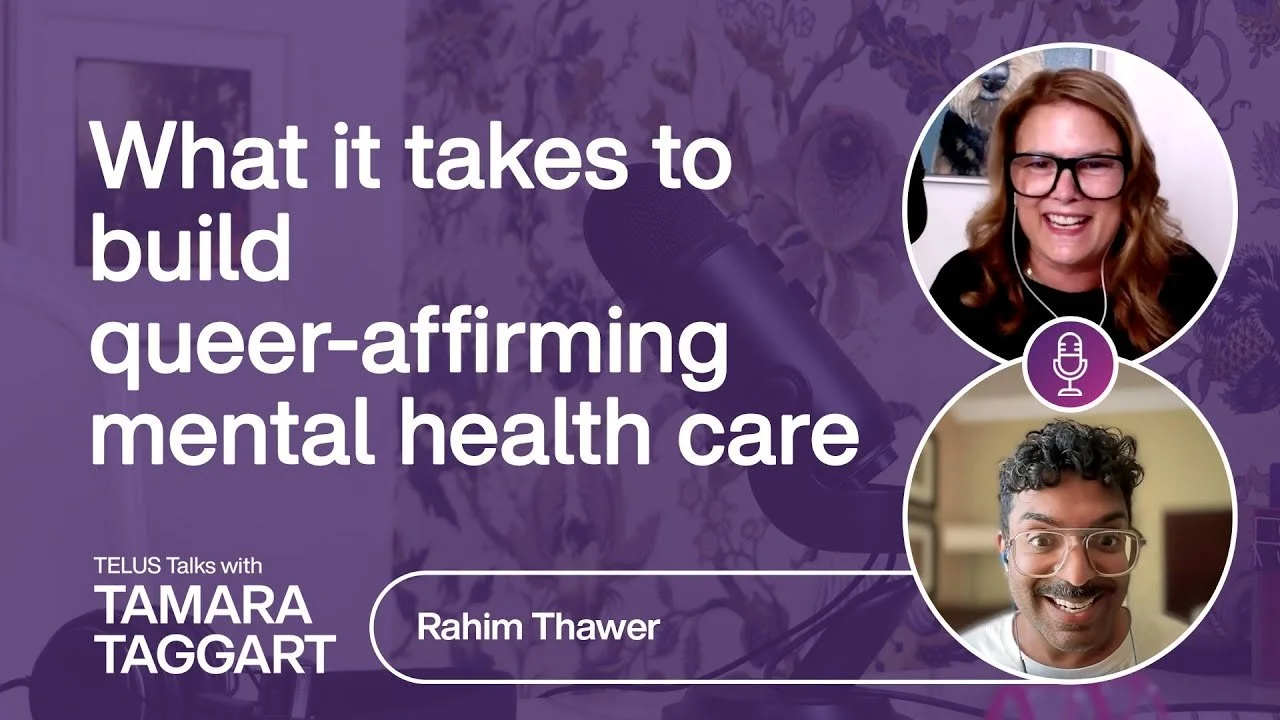
Podcast · TELUS Talks with Tamara Taggart · August 2025 · 37 min
Mental health tools often leave queer people out of the conversation. In this episode of TELUS Talks, host Tamara Taggart talks with Rahim Thawer about his book, The Mental Health Guide for Cis and Trans Queer Guys, which came out in June 2025, and about what inclusive, affirming care should look like for queer men and the people who support them.
Rahim explains that the book grew out of the rise in mental health literacy during the pandemic and out of earlier workshops on queer men's subcultures. Queer guys grow up with straight, cisgender messages about masculinity, progress and relationships, then come out into a community with its own history and norms around bodies, casual sex, substance use and non-traditional relationships. Unlike the public health model of social determinants, he says, the question is less about what you have and more about how you move through these norms. He also wanted to talk about queer men's mental health beyond HIV, while still treating the legacy of AIDS as one important determinant.
Asked whether mental health is political, Rahim says yes: microaggressions, homophobia, transphobia, fatphobia and narrow messages about masculinity live in our environments, not only in individuals. He describes social work's grounding in systems of oppression and the many roles he has held, including HIV and STI testing at a sexual health clinic. There he saw newly diagnosed men worry first about whether anyone would love them. Because HIV is tied to behaviour, it gets moralized, and he walks through how he helps a client prepare to disclose to family without abandoning himself.
The conversation turns to shame, the subject of the book's first chapter, and to a wider culture that remains sexually repressed. Rahim explains cognitive behavioural therapy (CBT) through an example of dreading a party alone: noticing the thought, weighing evidence for and against it, and building a balanced thought that fits the person's context rather than an empty affirmation. When feelings are too big, behaviour becomes the entry point. Each chapter pairs a CBT exercise with Gestalt role-play and "digging deeper" prompts drawn from psychoanalytic thinking.
Rahim suggests that anyone can use the book's approach by writing down the determinants in their own subculture, whether a church community or in-laws, and he describes his chapter on milestone heteronormativity, which invites readers to redefine progress. He closes by pointing to the free worksheets on the publisher's website and by reframing his work around the strength, resilience and relational innovation of the communities he serves.
What it covers
- Social determinants of queer men’s mental health
- Shame and internalized oppression
- HIV stigma and disclosure
- Using CBT in context
- Milestone heteronormativity
Related on this site
Archived record: doi.org/10.5281/zenodo.19166837