

Practice the decisions inside CBT, not just the techniques
The CBT Skills Lab is a collection of 17 interactive clinical simulations designed to help practitioners move from knowing what a CBT intervention is to deciding when, why, and how to use it.
Across the Lab, you will encounter clients whose presentations do not arrive neatly organized around a technique. You will have to decide what to ask next, distinguish similar-looking clinical processes, revise formulations when new information emerges, and notice when an intervention that makes sense in theory does not yet make sense for this client.
The simulations are designed primarily for graduate learners and early- to mid-career clinicians who already have some familiarity with cognitive behavioral therapy. They can also be used by instructors, supervisors, and experienced practitioners who want structured cases for discussing clinical reasoning.
What you are practicing
CBT is sometimes taught as a collection of interventions: thought records, behavioral activation, exposure, problem-solving, relaxation, self-monitoring, and behavioral experiments.
Clinical practice is harder. Before selecting an intervention, the practitioner has to determine what appears to be maintaining the problem, what the client is trying to change, what the behavior or cognition is doing in context, whether the proposed intervention actually tests the formulation, and whether the client understands and endorses the work.
The simulations are designed around that question. The point is not to memorize a path through a case. The point is to become more deliberate about the reasoning that produced your next clinical move.
Choose a clinical skill area
The CBT Skills Lab is organized around seven areas of clinical reasoning. Select an area to explore its simulations, clinical applications, and considerations.
Cognitive Inquiry & Behavioral Learning
Practice investigating predictions, beliefs, evidence, and behavioral learning without turning CBT into persuasion.
Explore this skill areaAction, Activation & Problem-Solving
Practice purposeful behavioral change while attending to feasibility, reinforcement, avoidance, and real-world constraints.
Explore this skill areaAvoidance, Anxiety & Physiological Arousal
Practice identifying what avoidance, safety behavior, compulsions, and physiological regulation are doing in the maintenance cycle.
Explore this skill areaObservation, Functional Analysis & Skills
Practice slowing down behavior, identifying sequences and functions, and deciding what information is actually worth collecting.
Explore this skill areaFormulation & Clinical Decision-Making
Practice selecting the next intervention when several CBT techniques could plausibly fit the same case.
Explore this skill areaContext, Culture, Power & the Therapeutic Relationship
Practice changing the formulation when identity, institutional experience, power, relationship, and context change what a thought or behavior means.
Explore this skill areaConsolidation, Generalization & Maintenance
Practice carrying treatment learning forward without treating recurrence as failure or a return to zero.
Explore this skill areaCognitive Inquiry & Behavioral Learning
Practice investigating thoughts, predictions, beliefs, and experience while keeping both therapist and client hypotheses open to revision.
Thought Record in Practice
Practice identifying the thought that is actually driving the emotional response, then investigate it without turning cognitive restructuring into persuasion.
What you will practice
Automatic thoughts, emotions, evidence, Socratic inquiry, alternative interpretations, and balanced responses.
Clinical considerations
A thought record should not become an exercise in proving that distressing interpretations are irrational. Some feared outcomes are possible, and some cognitions contain important contextual truths.
Behavioral Experiments in Practice
Practice turning a belief or prediction into something that can be investigated through experience.
What you will practice
Prediction specification, collaborative empiricism, experiment design, observable outcomes, and interpretation of ambiguous results.
Clinical considerations
Behavioral experiments should test a meaningful prediction rather than pressure clients into proving the therapist's formulation.
Behavioral Experiments in Practice: Advanced Application
Practice designing experiments when perfectionism and safety behaviors make apparently successful performance difficult to interpret.
What you will practice
Safety behavior analysis, experiment calibration, separating performance from learning, and interpreting results that are not straightforward.
Clinical considerations
An experiment that is too protected may never test the feared prediction. One that is unnecessarily intense can become a test of endurance rather than a useful investigation.
Action, Activation & Problem-Solving
Practice moving from broad goals to specific behavior while attending to function, reinforcement, feasibility, competing obligations, and structural constraint.
Behavioral Activation in Practice
Practice identifying the relationship between behavior, avoidance, reinforcement, and mood.
What you will practice
Activity monitoring, avoidance analysis, graded activation, reinforcement, and collaborative activity planning.
Clinical considerations
Behavioral activation is not stay-busy therapy. Reduced activity may reflect depression, but it can also reflect exhaustion, disability, caregiving demands, economic constraints, or unsafe environments.
Behavioral Activation in Practice: Advanced Application
Practice activation when the question is not simply whether the client is doing enough, but what different activities actually provide.
What you will practice
Functional analysis of activity, depleted reinforcement, mastery, pleasure, values, and graded re-engagement.
Clinical considerations
Activation plans should not reproduce the same productivity standards, self-criticism, or overfunctioning that may already be contributing to distress.
Problem-Solving in Practice
Practice recognizing when distress is attached to a problem that may actually be changed.
What you will practice
Problem definition, controllability, option generation, feasibility analysis, decision criteria, and implementation.
Clinical considerations
Not every painful situation is a distorted thought, and not every real problem is individually solvable. Problem-solving should not place responsibility for structural conditions solely on the client.
Problem-Solving in Practice: Advanced Application
Practice structured problem-solving when competing obligations and real-world constraints make every available option imperfect.
What you will practice
Complex problem definition, competing priorities, option generation, implementation planning, and decision-making under constraint.
Clinical considerations
A technically elegant plan that the client cannot realistically enact is not a successful intervention. Feasibility is part of formulation.
Avoidance, Anxiety & Physiological Arousal
Practice identifying what avoidance, reassurance, physiological regulation, rituals, and safety behaviors are doing in the maintenance cycle.
Exposure in Practice
Practice identifying what avoidance is teaching the client and designing exposure around meaningful learning rather than simply tolerating distress.
What you will practice
Exposure formulation, prediction testing, safety behavior analysis, hierarchy development, approach behavior, and learning review.
Clinical considerations
Exposure should be tied to a clear formulation and conducted with informed collaboration. It should not expose a client to unnecessary actual danger or become a test of compliance.
Relaxation Training in Practice
Practice using physiological regulation strategically without teaching the client that anxiety must disappear before they can function.
What you will practice
Physiological escalation, relaxation strategies, cue-controlled practice, and integration of regulation with behavioral goals.
Clinical considerations
Relaxation is not interchangeable with exposure. If it becomes a condition the client believes is necessary before entering feared situations, it may function as a safety strategy.
Exposure and Response Prevention in Practice
Practice separating exposure from the compulsive or neutralizing response that prevents new learning.
What you will practice
ERP formulation, overt and covert rituals, hierarchy calibration, reassurance, accommodation, response prevention, and learning review.
Clinical considerations
ERP is a specialized treatment. Treatment intensity should reflect impairment, willingness and capacity to engage, clinical complexity, practitioner competence, and appropriate supervision.
Observation, Functional Analysis & Skills
Practice turning broad descriptions into observable sequences and choosing skills based on function rather than surface appearance.
Self-Monitoring in Practice
Practice deciding what information is worth tracking and what burden of monitoring is clinically justified.
What you will practice
Operationalizing targets, selecting variables, designing monitoring tasks, reviewing patterns, and reducing unnecessary measurement burden.
Clinical considerations
More data is not automatically better data. Monitoring can become burdensome, perfectionistic, compulsive, shaming, or disconnected from treatment decisions.
Chain Analysis in Practice
Practice slowing down behavior that initially appears impulsive enough to discover the sequence that made it possible.
What you will practice
Vulnerabilities, prompting events, thoughts, emotions, action urges, behavior, consequences, and intervention points.
Clinical considerations
Chain analysis should clarify behavior, not become an interrogation or retrospective search for blame. Acute risk still requires appropriate assessment and safety procedures.
Assertiveness Training in Practice
Practice matching an interpersonal skill to the relationship, power structure, and consequences in which it will actually be used.
What you will practice
Requests, refusals, boundaries, behavioral rehearsal, interpersonal goals, and contextual calibration.
Clinical considerations
Assertiveness should not be taught as though every person faces the same consequences for direct communication. Social position and organizational context can change the risk attached to exactly the same behavior.
Formulation & Clinical Decision-Making
Practice deciding what the case needs next when several CBT techniques could plausibly apply.
Choosing the Next CBT Intervention
Organize a complicated presentation, identify maintaining processes, and decide whether the next move should involve cognition, behavior, exposure, activation, problem-solving, monitoring, or another direction.
What you will practice
Case formulation, treatment planning, competing hypotheses, sequencing, intervention selection, and knowing when more assessment is needed before choosing.
Clinical considerations
A familiar technique is not automatically the right technique. Intervention choice should follow the formulation rather than the practitioner's preferred tool.
Context, Culture, Power & the Therapeutic Relationship
Practice changing the formulation when identity, structural conditions, institutional experience, power, and the therapy relationship change what thoughts and behaviors mean.
Adapting CBT Across Culture, Identity, and Context
Practice changing the formulation when culture, identity, structural conditions, and lived experience alter what a thought or behavior means.
What you will practice
Culturally responsive formulation, contextual inquiry, structural analysis, power awareness, and intervention adaptation.
Clinical considerations
Adaptation should not become stereotyping. Identity does not determine formulation, and structural awareness does not require abandoning CBT.
When the Client Pushes Back
Practice treating disagreement as clinical information rather than automatically labeling it resistance.
What you will practice
Rupture recognition, collaborative empiricism, therapist reflexivity, treatment feedback, power-aware collaboration, and knowing when to persist versus revise.
Clinical considerations
Client discomfort does not prove an intervention is working. Client disagreement does not prove avoidance. Collaboration also does not mean abandoning clinical judgment whenever the client disagrees.
Consolidation, Generalization & Maintenance
Practice helping clients carry learning forward, anticipate recurrence, and respond to setbacks without framing them as treatment failure.
Maintaining Change and Planning for Setbacks
Practice helping clients carry treatment learning forward without promising that symptoms or old patterns will never return.
What you will practice
Consolidation, relapse prevention, early warning signs, maintenance planning, generalization, and booster planning.
Clinical considerations
Recurrence is not evidence that treatment failed or that the client failed to use skills correctly. Maintenance planning should anticipate changing contexts, stressors, resources, and access to support.
How to use the Lab
You do not need to complete the simulations in numerical order. Choose a specific intervention, a clinical reasoning domain, or begin with intervention selection if you want to practice formulation.
What did I notice?
Identify the clinical information that caught your attention before deciding what it means.
What did I assume it meant?
Notice the formulation, theory, prior experience, or bias that shaped your interpretation.
What did my next move change?
Consider what your intervention made easier to see and what it may have made harder to see.
A note about “contraindications”
The word contraindication needs some care in a CBT learning environment.
For many of the interventions represented in the Lab, the research does not support a simple universal list of diagnoses or client characteristics for which a technique is always prohibited.
More often, the clinically relevant questions concern treatment fit, readiness, safety, treatment intensity, practitioner competence, informed preference, comorbidity, functional impairment, context, and whether an intervention is being used according to a coherent formulation.
For this reason, individual simulation descriptions use Clinical considerations rather than treating contraindication as a simple yes or no category.
Sources informing the CBT Skills Lab
The simulations draw on established CBT scholarship and clinical guidance concerning cognitive formulation, behavioral intervention, collaborative empiricism, behavioral activation, exposure, skills training, treatment planning, therapeutic process, and relapse prevention.
The development of individual simulations also draws on the CBT teaching materials, slide decks, clinical transcripts, and reflection materials developed for The CBT Dive and associated course materials.
View APA depression guideline
View APA CBT handbook
View APA book information
View NICE CG113 recommendations
View NICE CG31 recommendations
View NICE NG116 recommendations
The CBT Skills Lab is a practice environment, not a substitute for training or supervision.
The CBT Skills Lab is designed to support learning, clinical reasoning, reflection, and discussion. It does not replace formal training that includes instruction, observed practice, feedback, competency evaluation, or clinical supervision.
Anyone may use the Lab as a learning resource. Using a simulation does not establish competence to deliver the intervention represented in it.
Practitioners remain responsible for ensuring that they practice within their professional scope, training, competence, licensure requirements, organizational policies, and applicable ethical and legal standards.
When a technique requires specialized training or supervision, particularly exposure-based treatment, trauma-focused CBT, or ERP, the simulation should be understood as preparation for deeper learning, not authorization to practice independently.
Learn the intervention. Practice the reasoning. Know the limits of the simulation.
Read, watch and listen
Thoughts in their actual context
Watch a thought record unfold in a simulated conversation about sexual needs and communication, then consider how structural conditions become personal explanations for distress.
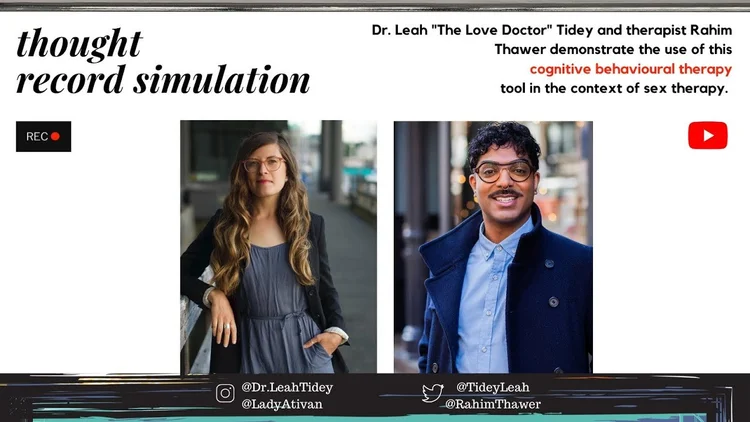 CBT thought record simulation with Rahim and LeahWatch a thought record unfold in a simulated sex therapy session about communicating sexual needs to a partner.
 How Capitalism Turns Inequality into Self-BlameHardship is not only material, it is also interpreted. How capitalism teaches people to read inequality as personal failure.
Where to go next
CBT templates
Free, editable thought records, activity plans and exposure hierarchies to use with clients.
Clinical supervision
Case consultation that treats power, identity and context as part of the clinical picture.
The CBT Dive
Watch a thought record done out loud with real guests, in a free video podcast.