Connection seeking and mental health
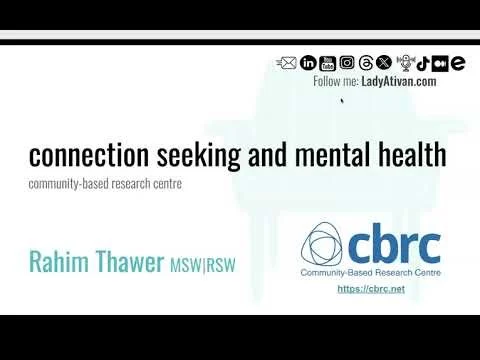
Webinar · Community-Based Research Centre (CBRC) · March 2024 · 1 hr 27 min
In this webinar for the Community-Based Research Centre, Rahim speaks to service providers who work with cis and trans gay, bi and queer men. He argues that because much publicly funded programming is tied to sexual health and HIV outcomes, the wider landscape in which queer and trans guys seek connection often goes unaddressed, even though it shapes their mental health.
He begins with conflicting cultural scripts. Dominant culture treats casual sex as a gap between serious relationships and equates long-term commitment with monogamy and maturity, while the gay subculture many men join after coming out frames sex as liberation and a way to belong, and sometimes treats wanting marriage as too normative. Rahim then outlines a theory of his own he calls “the trap”: when difficult feelings arise in casual sex or in a relationship, and people lack tools to work through them, they defer to the other script and bounce between the two. He suggests that symptoms such as low mood or withdrawal can be read partly as adaptations to this landscape.
Next, he maps the rewards and challenges of each pursuit. Casual encounters can offer validation, pleasure, room for an evolving sexuality and a sense of participating in community, but also bring rejection, sexual role expectations, racialized and body-based exclusion on apps, shame-driven anxiety about STBBIs, and ageism toward older men. Long-term relationships offer deeper intimacy, the growth that comes from resolving conflict, visibility with family and a chance to rework core beliefs about being unlovable; their challenges include alcohol-soaked meeting spaces, disagreements over labels, mourning single life and negotiating openness without framing it as failure. He suggests providers ask what an STBBI would mean to a client, and points to Tristan Taormino’s questions for creating authentic relationships.
Rahim then introduces dating-app language such as breadcrumbing, ghosting, haunting and orbiting, and reviews research on swipe-based apps, sexual minority Black men’s experiences of racialized objectification, and trans users who feel affirmed yet fetishized. He offers CBT-informed self-talk for managing rejection and a set of app emotional hygiene strategies: watching for the casino effect, redefining success, matching a profile’s text to what you want, scrolling less, noticing underlying emotional needs, having a containment plan and cultivating relationships beyond the apps.
In the question period he discusses impostor feelings among bi and trans men in spaces built around cis gay men, coaching trans clients on disclosure in cruising and kink spaces, preparing someone for a first bathhouse visit, and building low-barrier queer community wherever people live.
What it covers
- Conflicting relationship scripts
- Rewards and challenges of casual sex and long-term relationships
- Dating app phenomena and research
- Managing rejection
- App emotional hygiene
- Building community beyond apps
Related on this site
Archived record: doi.org/10.5281/zenodo.19036312