You’re Queer, Not Broken!
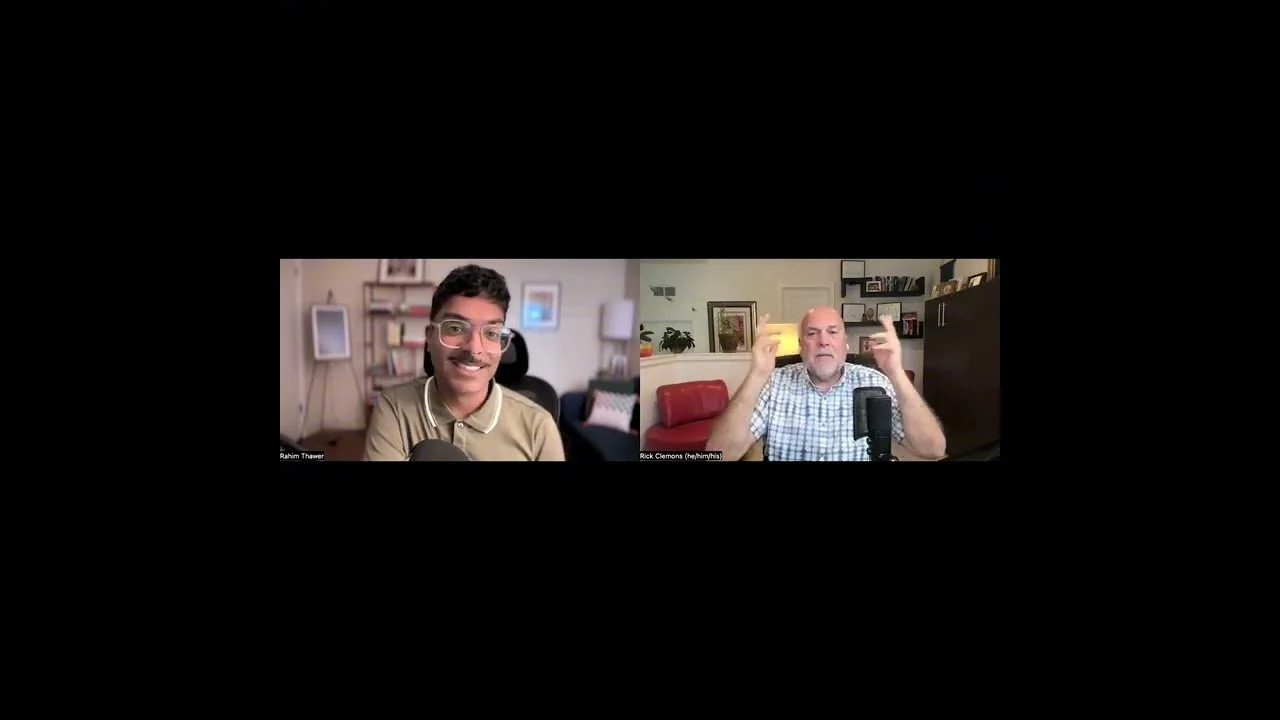
Podcast · 40 Plus: Gay Men. Gay Talk. with Rick Clemons · May 2025 · 44 min
On 40 Plus: Gay Men. Gay Talk., host Rick Clemons talks with Rahim about The Mental Health Guide for Cis and Trans Queer Guys, released shortly after the episode aired, and about the mental health challenges that are specific to queer men.
Rahim begins with socialization. Queer guys were raised as men in a world that did not encourage vulnerability, and many learned early to expect rejection and to rely on themselves. As adults, that can mean not knowing how to ask for help, receive it or talk about feelings. He credits transmasculine friends with holding up a mirror to cisgender gay men's blind spots, including their discomfort with femininity. Discussing why some men bristle at being called "girl" while others shrug off "daddy," he suggests the first often touches childhood messages about not being man enough.
From there Rahim describes the idea behind the book: that each person can map the dominant culture and the subculture they move through, and ask what in that environment shapes how they feel about themselves, other people and their future. Coming out, he notes, carries grief as well as relief. Friends may place you in a rigid box, and learning the norms and rituals of queer culture takes time and brings its own stress.
He explains that the book grew out of years in the HIV sector, where programming for queer men tied every issue back to prevention. He treats sexual health as one determinant of mental health among several, alongside body image, substance use and how men navigate the landscape of relationship seeking, where both long-term partnership and casual sex are celebrated and criticized. Approaching 40 himself, he reflects on the grief of letting go of milestones that won't be reached and the loneliness of creating milestones others may not recognize.
The conversation turns to connection. Rahim points to the lack of in-person spaces beyond bars or crisis-driven gatherings, and to dating apps that encourage ranking bodies and chasing proximity to externally defined value. When Rick describes men in big cities who avoid commitment because they might move, Rahim names it as avoidant attachment presented as logistics. He argues that queer people can rethink endings: a relationship that ends has not failed, it has lived its course. He closes by encouraging listeners to see their whole environment as part of their mental health and to make room for their own milestones.
What it covers
- Rejection sensitivity and self-reliance
- Masculinity and femininity
- Grief and coming out
- Body image and dating apps
- Rethinking relationship endings
- Aging and milestones
Related on this site
- Psychotherapy with Rahim
- Essay: What gay men must give up to embrace everyday bodies
- Essay: Sexuality and the imprint of shame
Archived record: doi.org/10.5281/zenodo.19035821