

CBT thought record simulation with Rahim and Leah
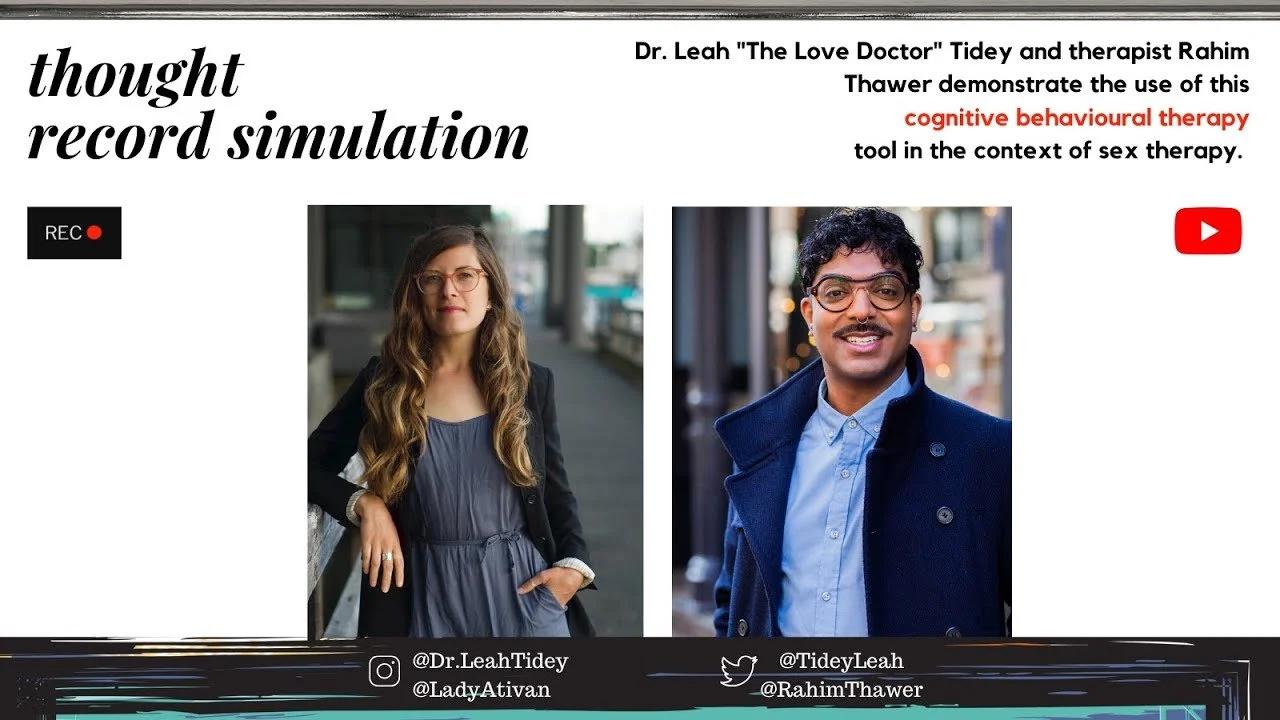
Demonstration · The Love Doctor with Dr. Leah Tidey · May 2021 · 1 hr 26 min
Thought records are one of the core skills taught in cognitive behavioural therapy (CBT). In this conversation for The Love Doctor, Rahim and Dr. Leah Tidey run a simulated session to show how a thought record can be used in sex and relationship therapy. Leah plays a client who is struggling to ask a partner for what she wants sexually.
Rahim opens with an overview of CBT. He outlines four main tools: behavioural activation for low motivation, thought records for situations that stir up unhelpful thinking and intense feelings, problem solving for hard decisions based on objective information, and behavioural experiments for trying something new. He stresses that a thought record should never be used to question a systemic reality such as an experience of racism or sexism.
The simulation follows an eight-column thought record. Leah describes wanting to tell her partner, just before sex at the end of the day, that she wants to receive oral sex without reciprocation. They name a web of feelings, including embarrassment, uncertainty, seduction, confidence, shame, self-consciousness and what Rahim calls anticipatory rejection, rate each from one to ten, then trace what she does when she doesn't speak up.
Rahim asks follow-up questions to distill the automatic thoughts into underlying beliefs: that pleasure should be reciprocal, that the one who receives more holds more power, that her body may not be alluring enough, and that a no would erode her confidence. Two hot thoughts emerge, one about unequal power and one about sexual incompatibility. Rahim notes that the second sounds less like a hard conversation and more like anticipated grief. They choose the incompatibility thought, weigh evidence for and against it, and build alternative thoughts. The one Leah believes most is that she can stay dominant and verbal throughout while checking in with her partner. When they re-rate her feelings, shame and anxiety drop, and excitement, playfulness and feeling empowered and present appear.
In the debrief, Rahim explains that the goal is not to erase difficult feelings but to reduce their intensity so other feelings have room. He cautions that going to the core of a belief can raise anxiety, so the alternative thought must answer the hot thought directly. He suggests feeling sheets and whiteboards for clients who struggle to put feelings into words, prefers to do several thought records in session before assigning them as homework and frames CBT as an experiment that mixes well with other modalities.
What it covers
- Thought records
- Automatic thoughts and core beliefs
- Communicating sexual needs
- CBT in sex therapy
- Anticipatory rejection
Related on this site
Archived record: doi.org/10.5281/zenodo.19037666