2SLGBTQIA+ Muslims and mental health
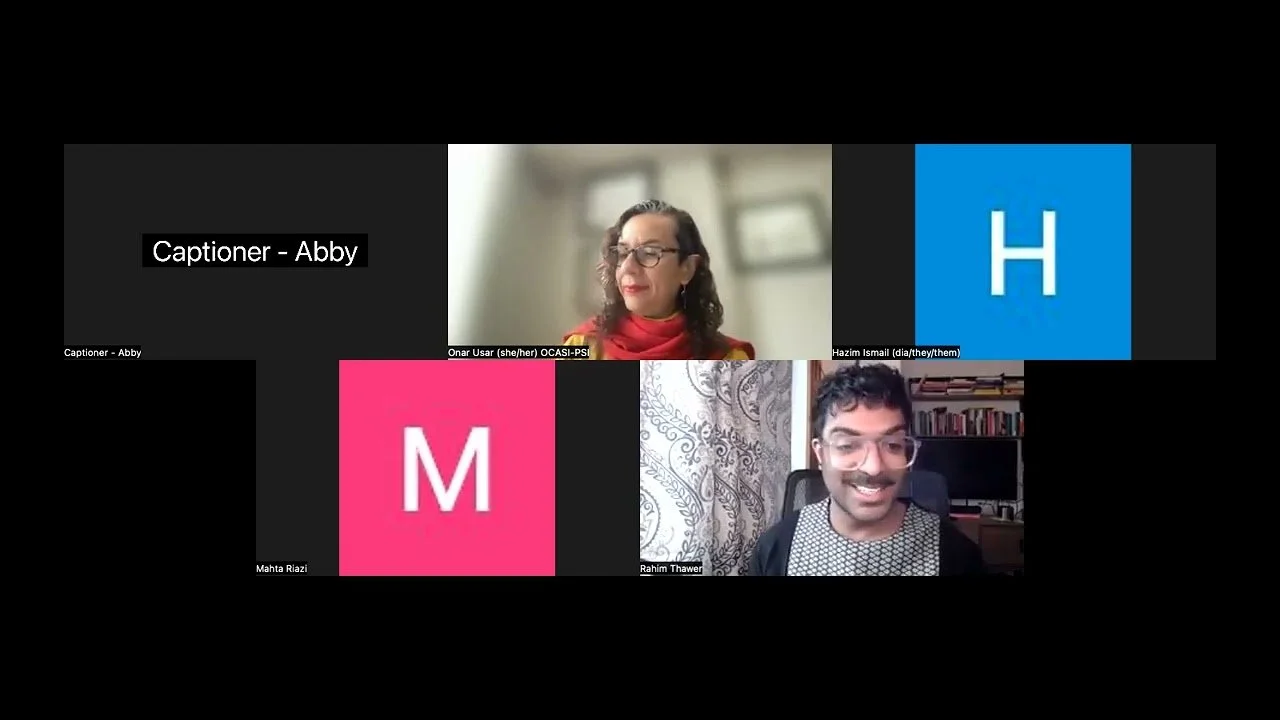
Webinar · Ontario Council of Agencies Serving Immigrants (OCASI) · December 2023 · 1 hr 19 min
An OCASI Positive Spaces Initiative webinar on the mental health of 2SLGBTQIA+ Muslims, organized to address gaps in resources for the immigrant and refugee serving sector amid rising Islamophobia and anti-2SLGBTQI+ hate. Rahim draws on more than a decade of volunteering with Salaam Canada and asks listeners to honour people’s dignity without conditions on how they believe or practise.
He begins by showing how culturally diverse Muslims are worldwide, then examines mental health paradigms common in Muslim communities: illness as a lapse in faith, suffering as a normal part of life, hardship as a test, and ideas of jinn and the evil eye. He reverses the “test” framing, arguing that the test belongs to straight and cisgender communities to stop treating queer people as disposable. He notes that faith communities can be protective, recalling that his own congregation never mocked his gender expression the way school peers did.
On coming out, Rahim critiques the dominant liberation narrative, distinguishing what is private from what is secret and describing acceptance that shows up in food and family meals rather than Pride marches. He encourages practitioners to help clients find the grey space between identities framed as opposites, and to treat integration as a project of growth rather than a problem imbued with loss, guilt and shame.
He treats reconciling identities as contested but real, explaining why being queer and Muslim are held together and how Muslims are racialized regardless of belief. He describes where people seek affirmation, from peers and social media to queer-affirming scholarship and archival projects, and shares a video in which queer Muslims reflect on faith, family and reconciliation.
Rahim then discusses disenfranchised grief, from mourning mosque attacks without a religious community to pinkwashing during the war in Gaza, along with internalized Islamophobia and the idea of competing selves whose relationship to faith evolves over a lifetime. He highlights resistance within Muslim communities and closes with takeaways for service providers: resist racist dichotomies and homonationalism, do not promise that Canada is uniformly safe, and use reflexivity to examine one’s own biases.
What it covers
- Faith and sexuality
- Mental health paradigms in Muslim communities
- Coming out and reconciling identities
- Disenfranchised grief
- Internalized Islamophobia
- Affirming clinical practice
Related on this site
- Essay: How to be culturally competent when supporting LGBTQ+ Muslims
- Essay: Identity formation theory and queer Muslims
- Books
Archived record: doi.org/10.5281/zenodo.19036497