

Free interactive learning resources
EFT-Informed Simulations
Interactive exercises for seeing what happens underneath recurring relationship conflict.
Follow fictional characters through moments of hurt, shame, withdrawal, pressure, misunderstanding, and repair. Each simulation uses an EFT-informed relational loop to explore how moments of disconnection can activate meaning, emotion, and protective responses between partners.
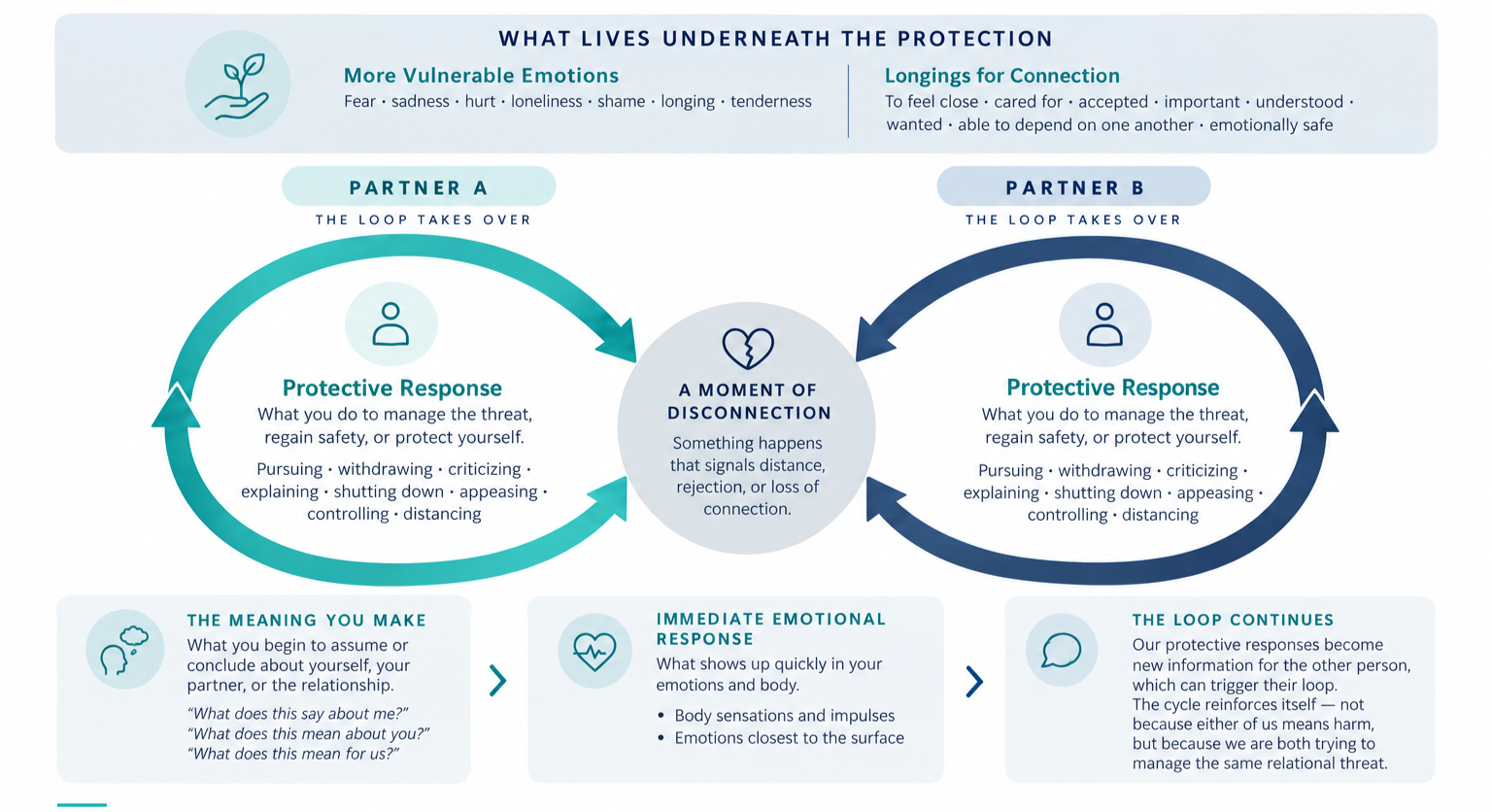
What we do to protect ourselves can become part of what the other person reacts to next. Slowing the loop down helps us notice what is happening between us and what may be happening underneath.
Choose a simulation
Six relationships. Six different loops.
Start anywhere. Your choices change what gets revealed, but there is no “correct” path.
The Unanswered Message
When silence starts saying more than either person intended.
Ari sends Malik a message. Malik reads it while overwhelmed at work and does not reply. Follow how hurt, shame, protest, and withdrawal begin reinforcing one another.
Start simulation →Trying to Help
When care begins to feel like criticism.
One partner tries to help solve a problem. The other begins to feel managed, corrected, or treated as incapable.
Start simulation →Whose Family Comes First?
When belonging in one relationship creates risk in another.
Priya and Noor are engaged, but Noor's family still knows Priya as a friend. Explore what happens when attachment, disclosure, family loyalty, and identity collide.
Start simulation →Not Tonight
When sexual refusal starts carrying meanings about desirability and pressure.
Mei initiates sex. Samira says no. Follow how desire, rejection, reassurance, affection, and sexual agency begin becoming emotionally entangled.
Start simulation →The Decision Was Already Made
When having a final vote is not the same as having meaningful influence.
Rohan receives a job offer in another city. By the time Anika understands how far the decision has progressed, much of the planning is already done.
Start simulation →We Agreed This Was Okay
When an agreed freedom activates feelings neither person expected.
Eli and Marcus are in a negotiated open relationship. Marcus has an agreed outside encounter, and Eli discovers that knowing something is permitted does not predict how it will feel.
Start simulation →How these simulations work
You are examining a system, not passing a test.
You'll follow fictional characters through a conflict and choose what a person might be feeling or making of the situation. Your choice changes what gets revealed next.
There is no score. The goal is to practice seeing the pattern beneath the behavior rather than identifying the healthiest person or the correct response.
The relational loop
What one person does to protect themselves can become part of what the other reacts to.
In Emotion-Focused Couples Therapy, recurring conflicts are often understood as circular rather than linear. A moment of disconnection can quickly activate emotion, meaning, and a protective response. That response then becomes new information for the other person, whose own protective system may activate in turn.
Underneath these visible responses may be experiences that are harder to express directly: fear, hurt, sadness, loneliness, shame, longing, or tenderness. These experiences often sit alongside needs to feel cared for, understood, valued, wanted, accepted, important, or emotionally safe.
Understanding the loop does not mean assuming that responsibility is always equal or that power disappears. It means paying attention to how an interaction can become increasingly predictable, even when each person is trying to protect something important.
Use them your way
Stay with the fictional relationship first.
On your own
Use the fictional relationship as a thought experiment and notice what becomes easier to see once the interaction slows down.
With a partner
Complete the same simulation separately, then compare what each of you noticed without turning the differences into a right/wrong test.
With a therapist
Use a fictional loop as a starting point before considering whether parts of the pattern resemble something you want to understand more personally.
Clinical framework
Clinically grounded, not clinical.
These simulations are informed primarily by Emotion-Focused Couples Therapy, including work on attachment, identity, shame, attraction, unmet needs, power, and recursively maintained relational cycles.
The Relational Loop is an adapted teaching framework for helping learners slow down and notice moments of disconnection, immediate emotional responses, meaning-making, protective responses, more vulnerable emotions, and longings for connection.
Some simulations also draw on complementary frameworks where appropriate. We Agreed This Was Okay, for example, incorporates concepts from Relationship Innovation Counseling to distinguish emotional activation from relationship structure and negotiated agreements.
Start anywhere
New to the relational loop?
Begin with The Unanswered Message. It offers the clearest introduction to how moments of disconnection, meanings, emotions, and protective responses can begin reinforcing one another.
Start The Unanswered Message →